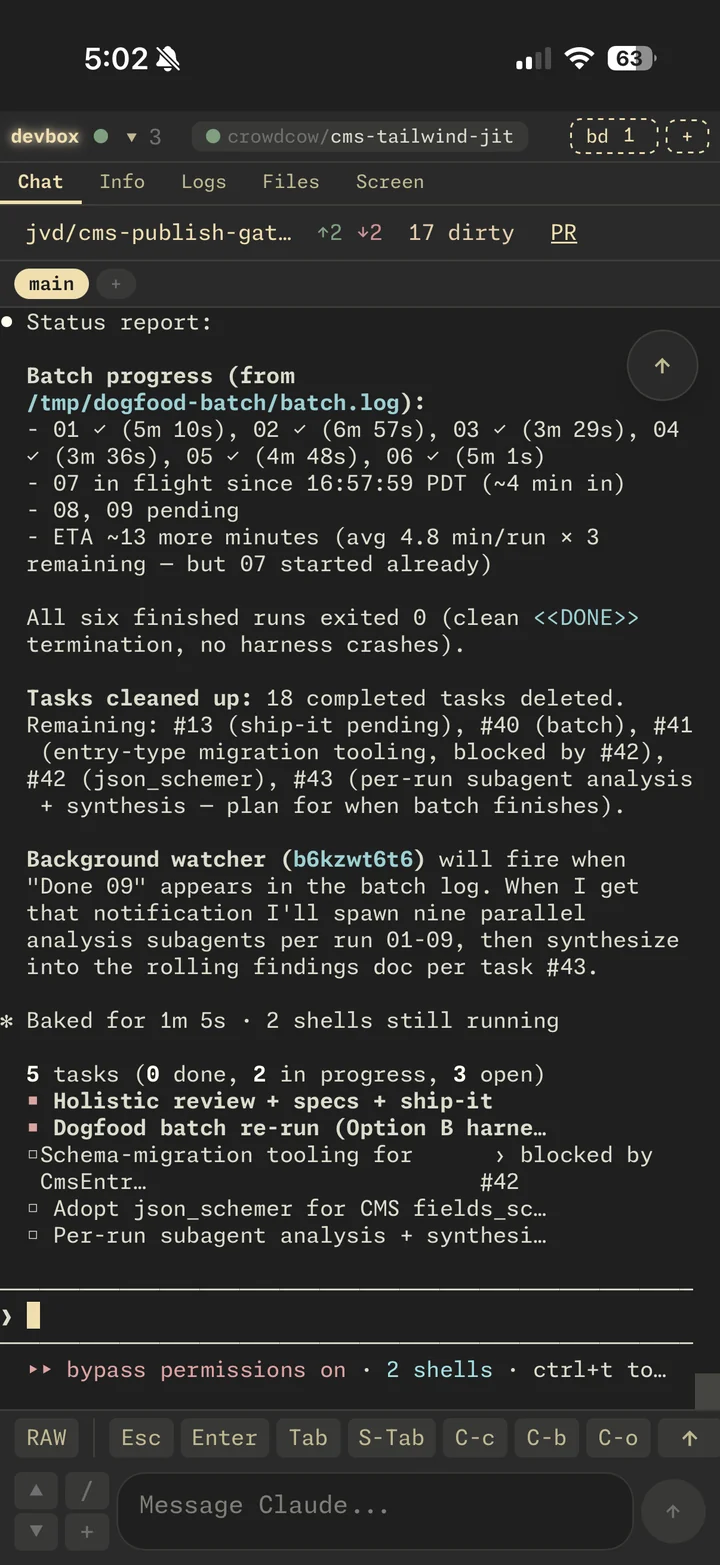
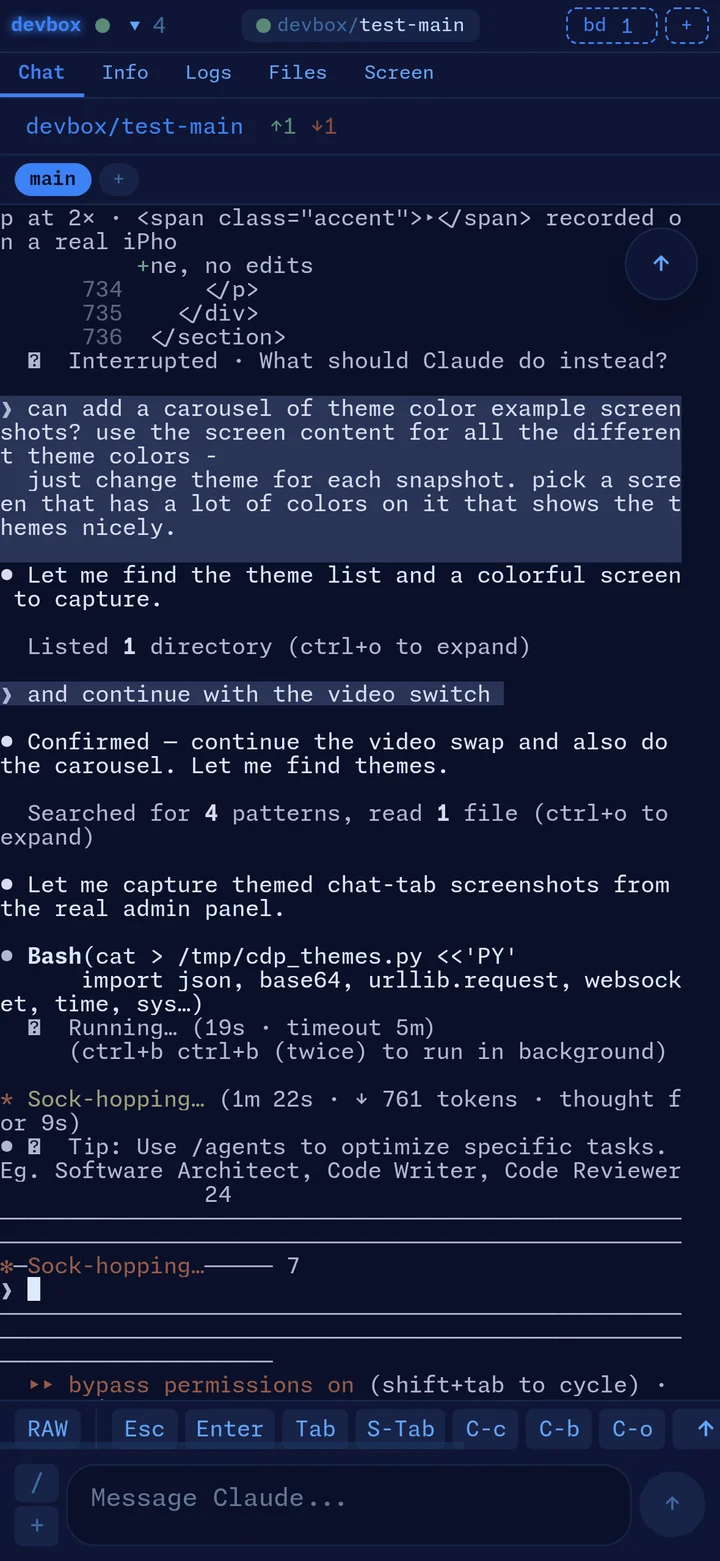
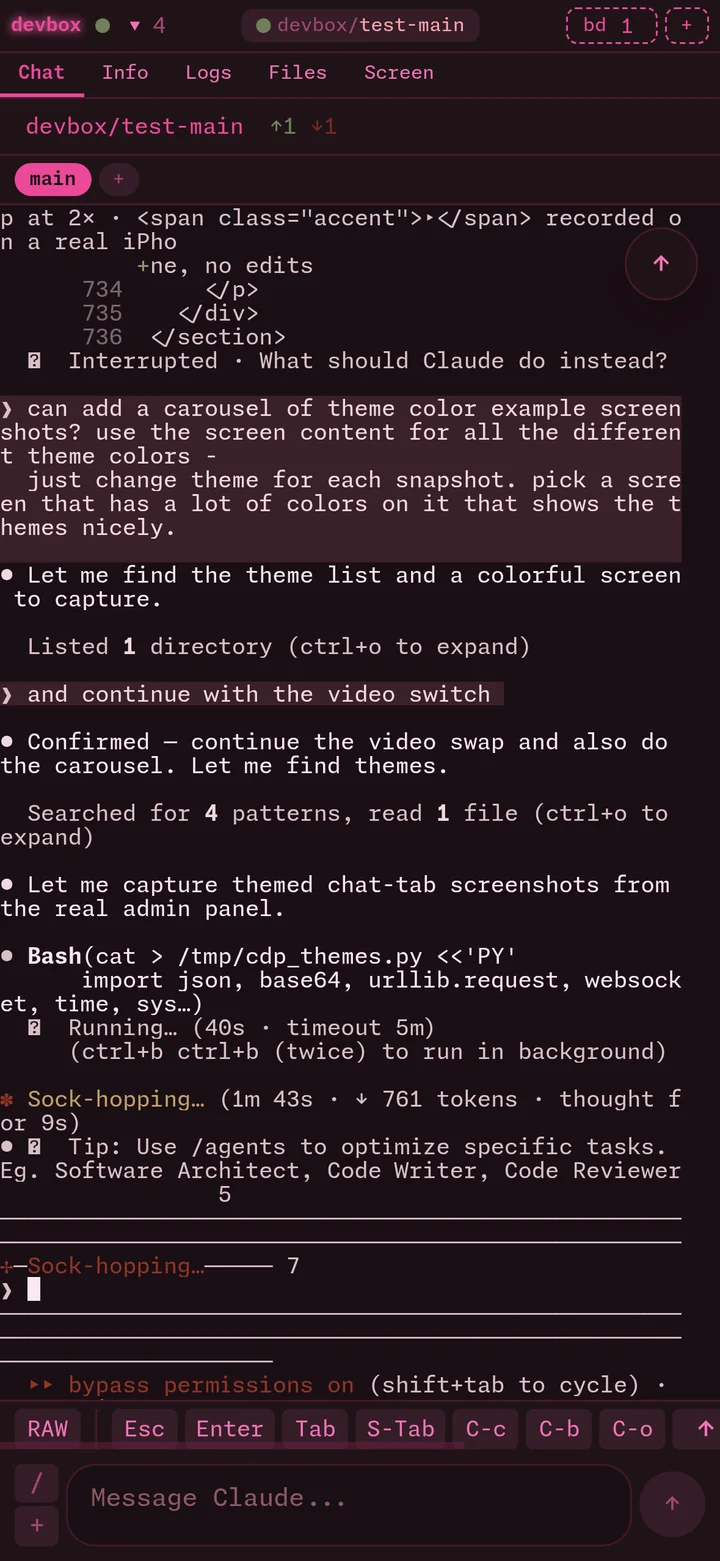
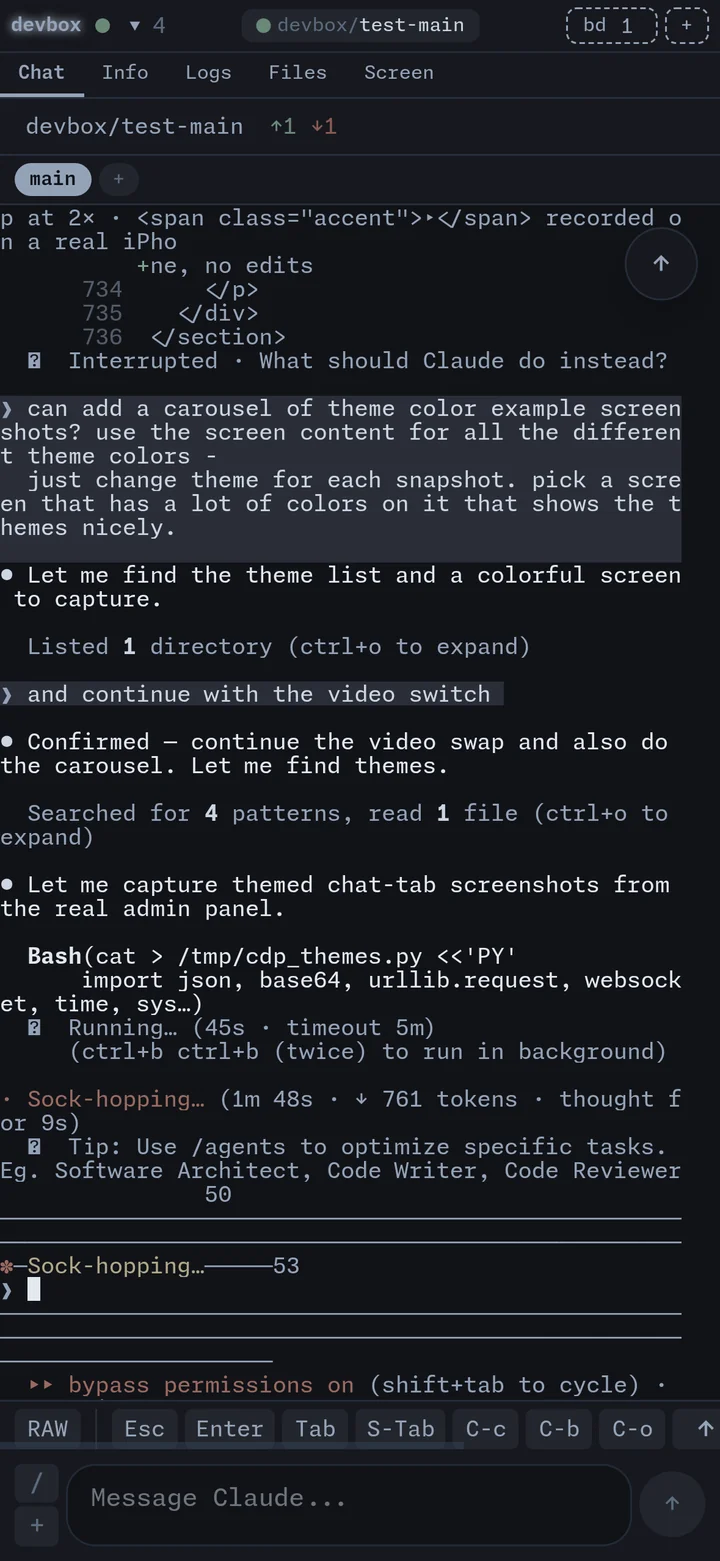
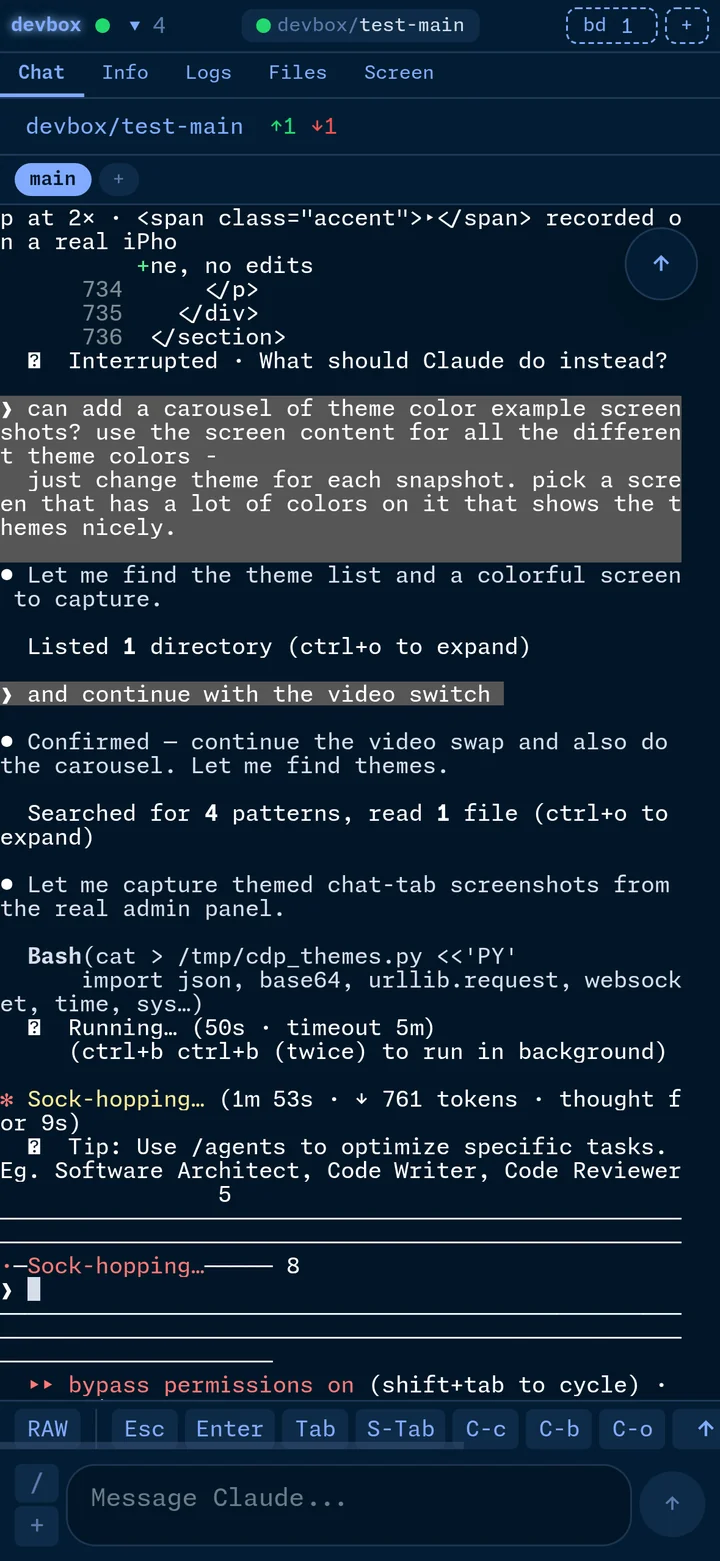
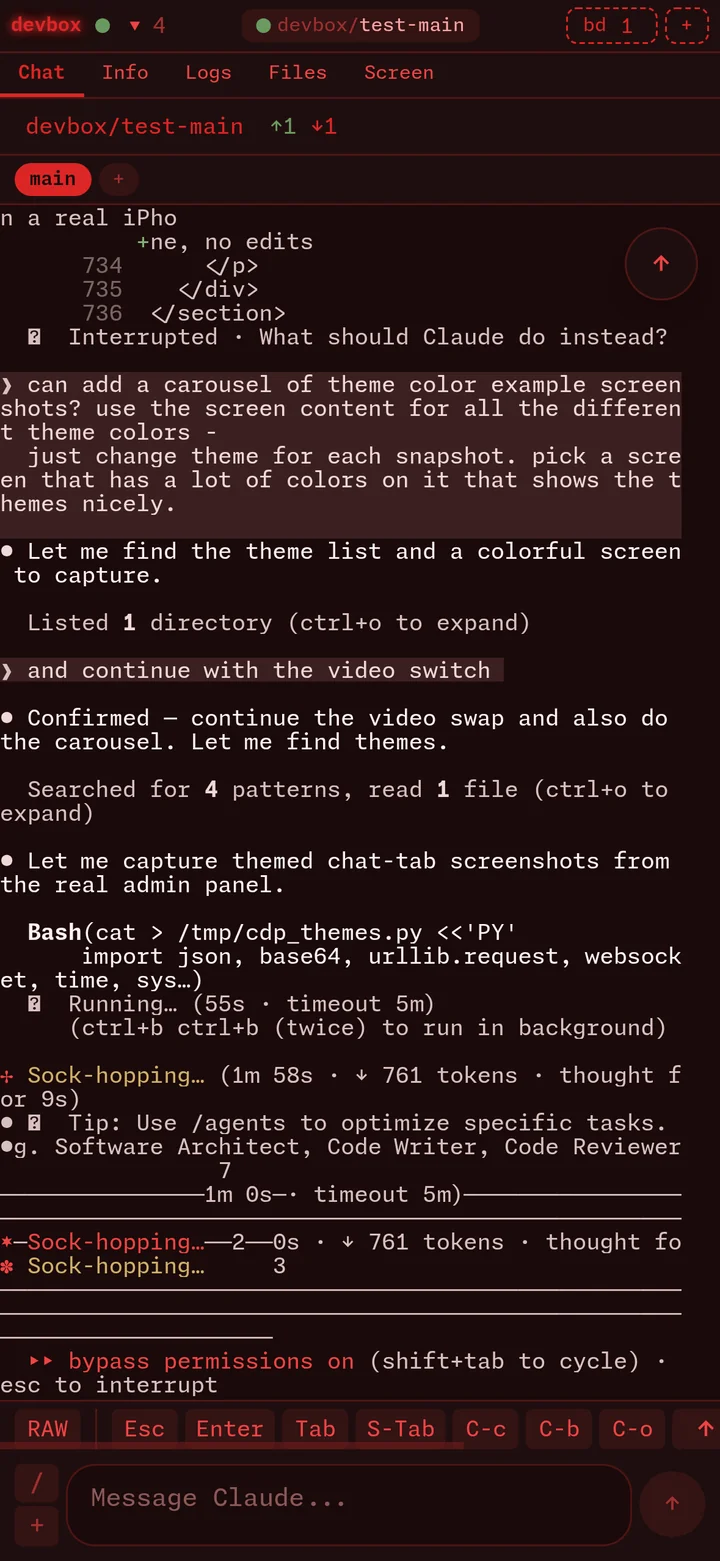
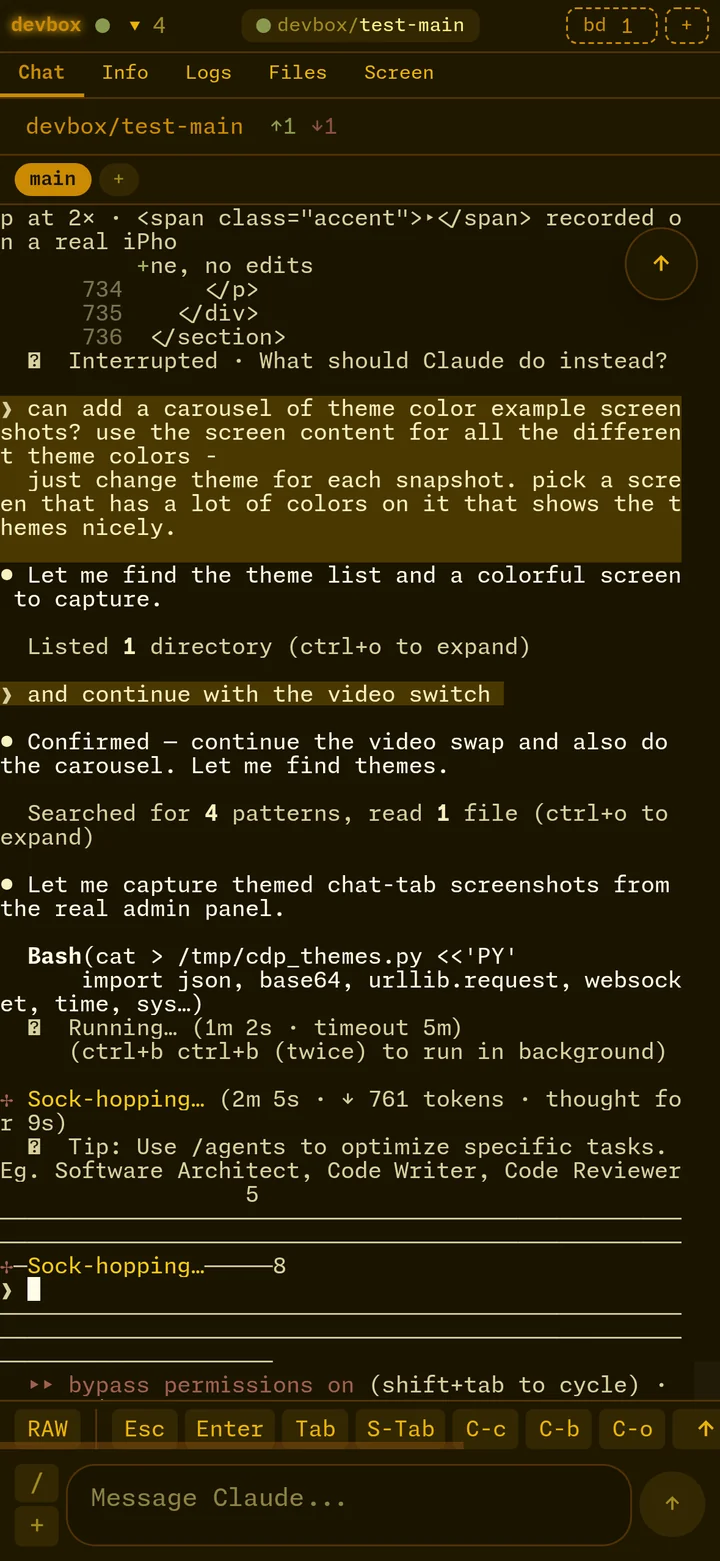
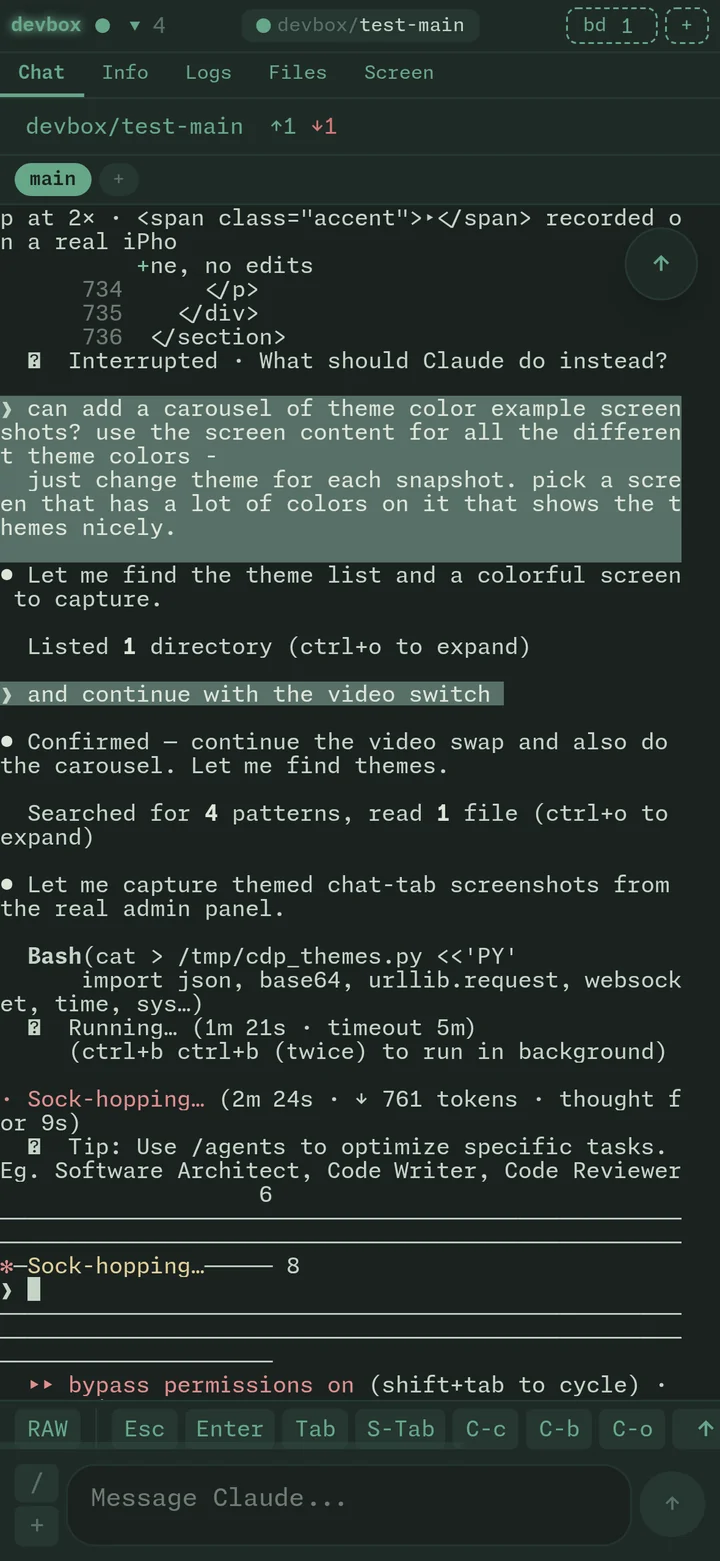
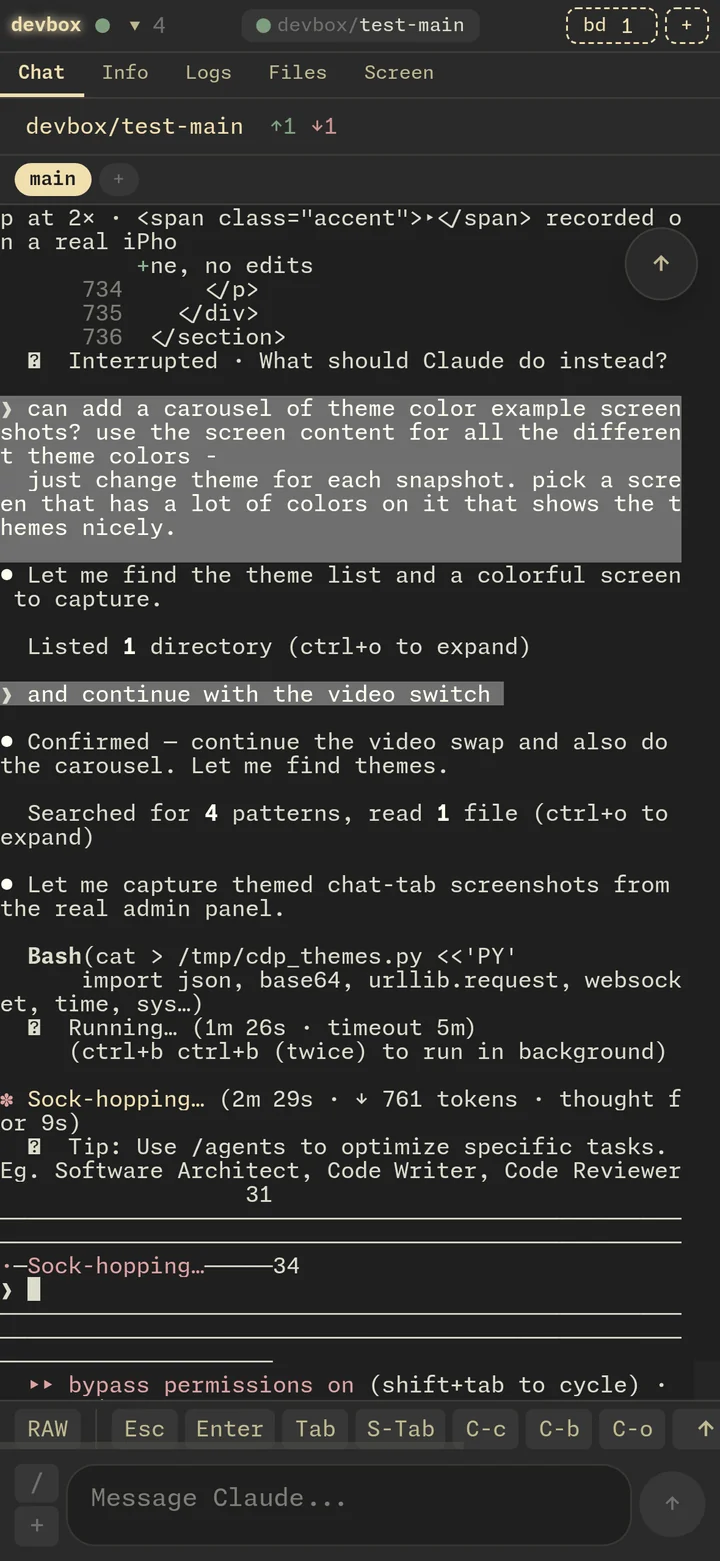
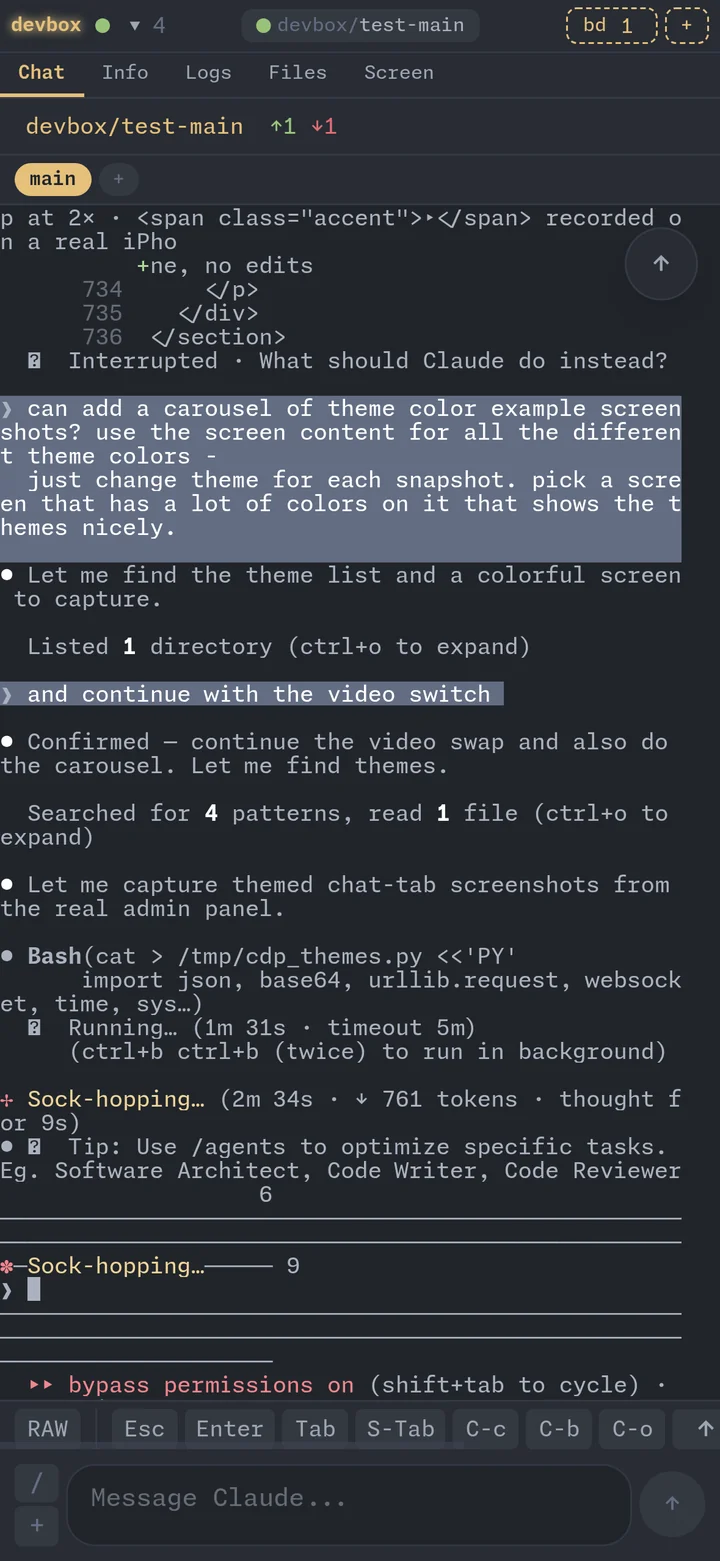
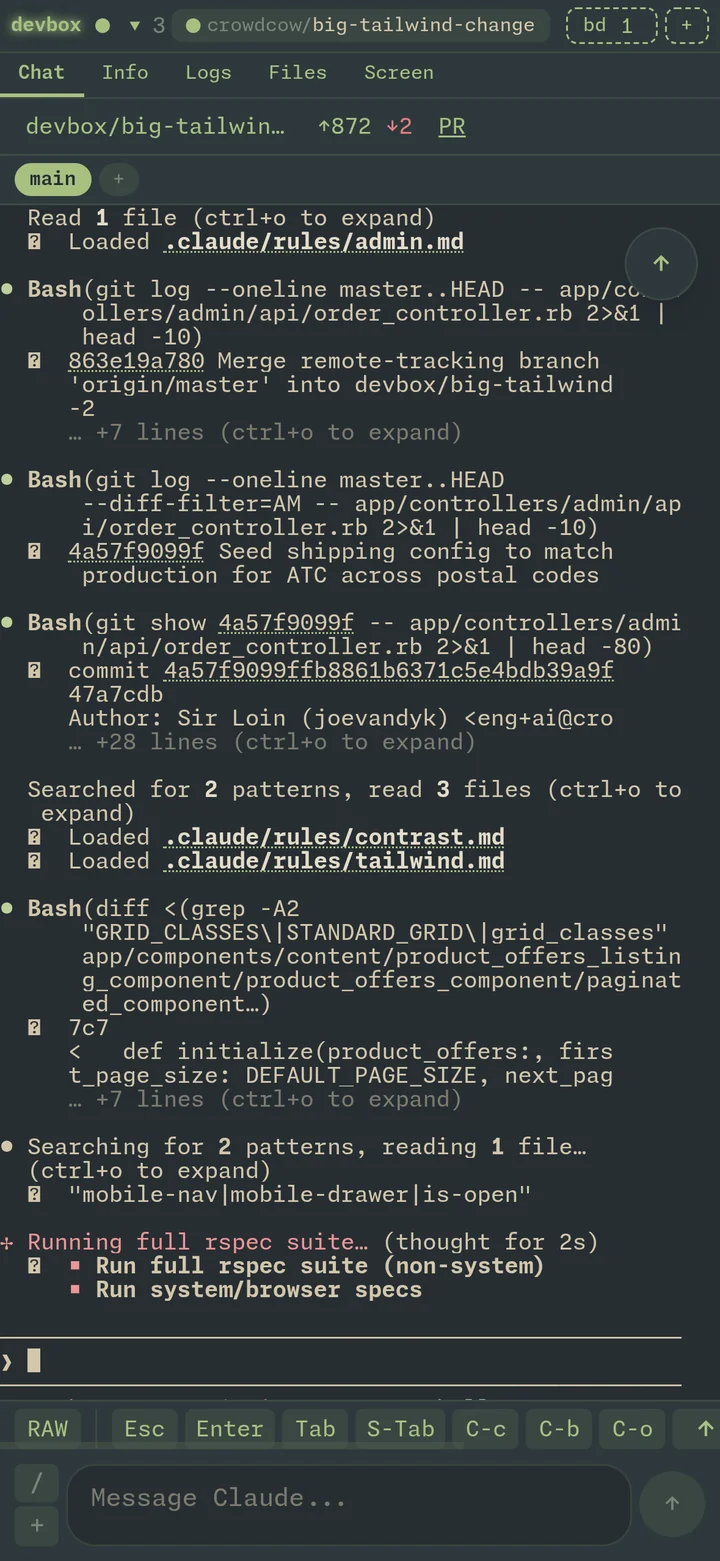
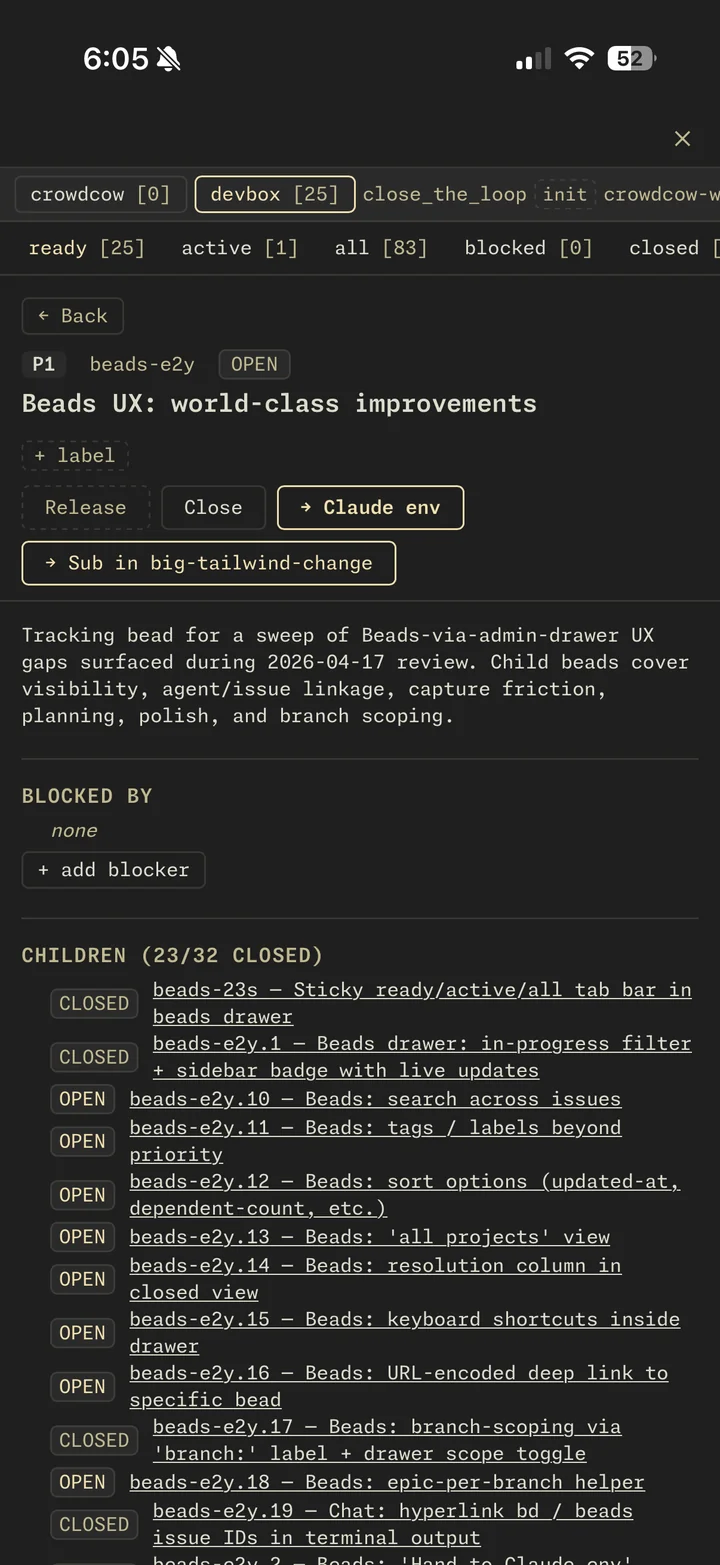
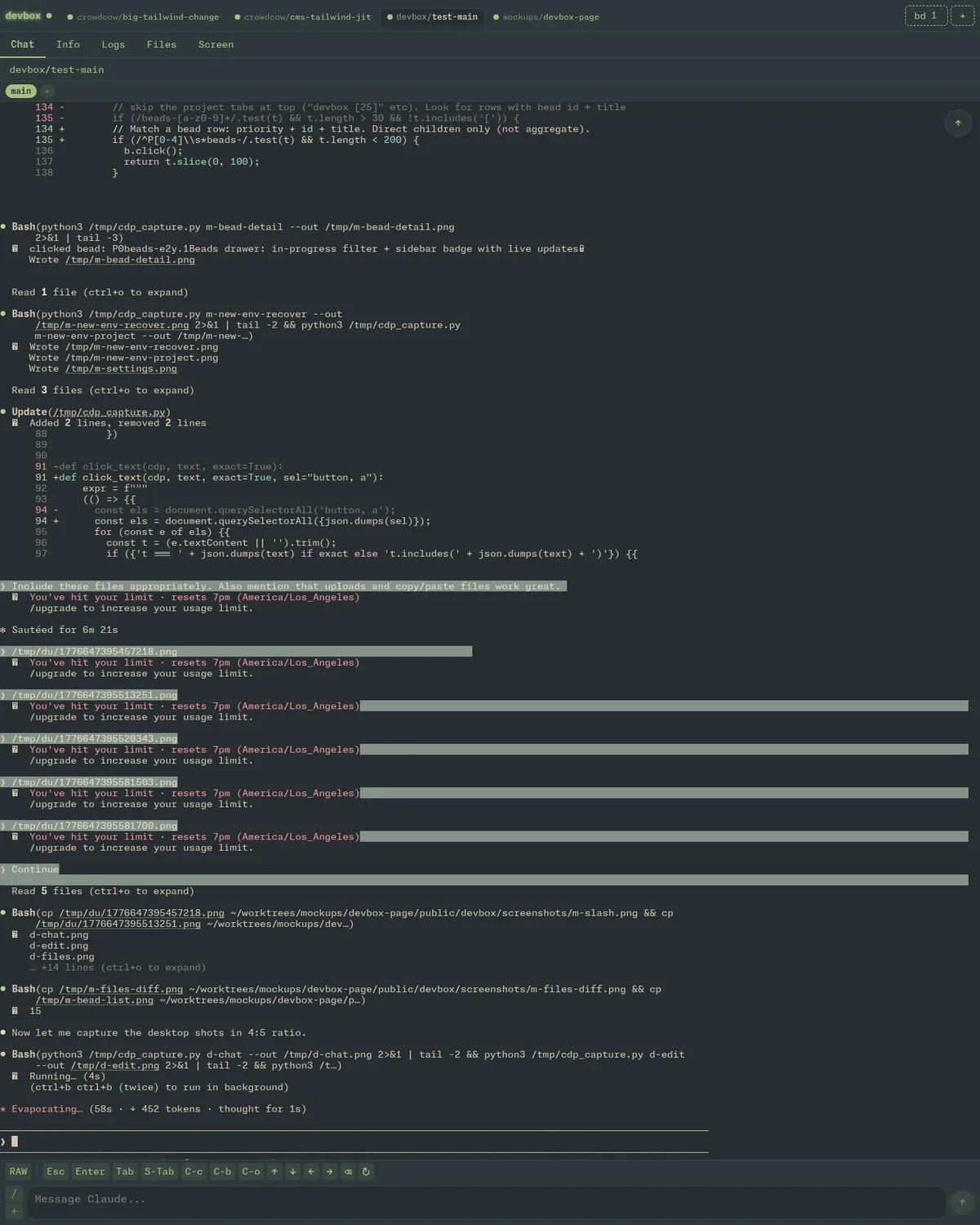
Spawn a Claude. Hand it a worktree. Watch it ship — from your phone. Devbox runs N isolated Claude Code agents on a bare-metal box, each in its own devcontainer, each driveable from a chat tab that fits in your hand.
Devbox is one developer's answer to "how do I run fifteen claudes and subagents at once and still know what they're all doing?" — a remote bare-metal server, a Go CLI, and a web admin panel that lives on an iPhone home screen. It's not a product. It's the workshop.
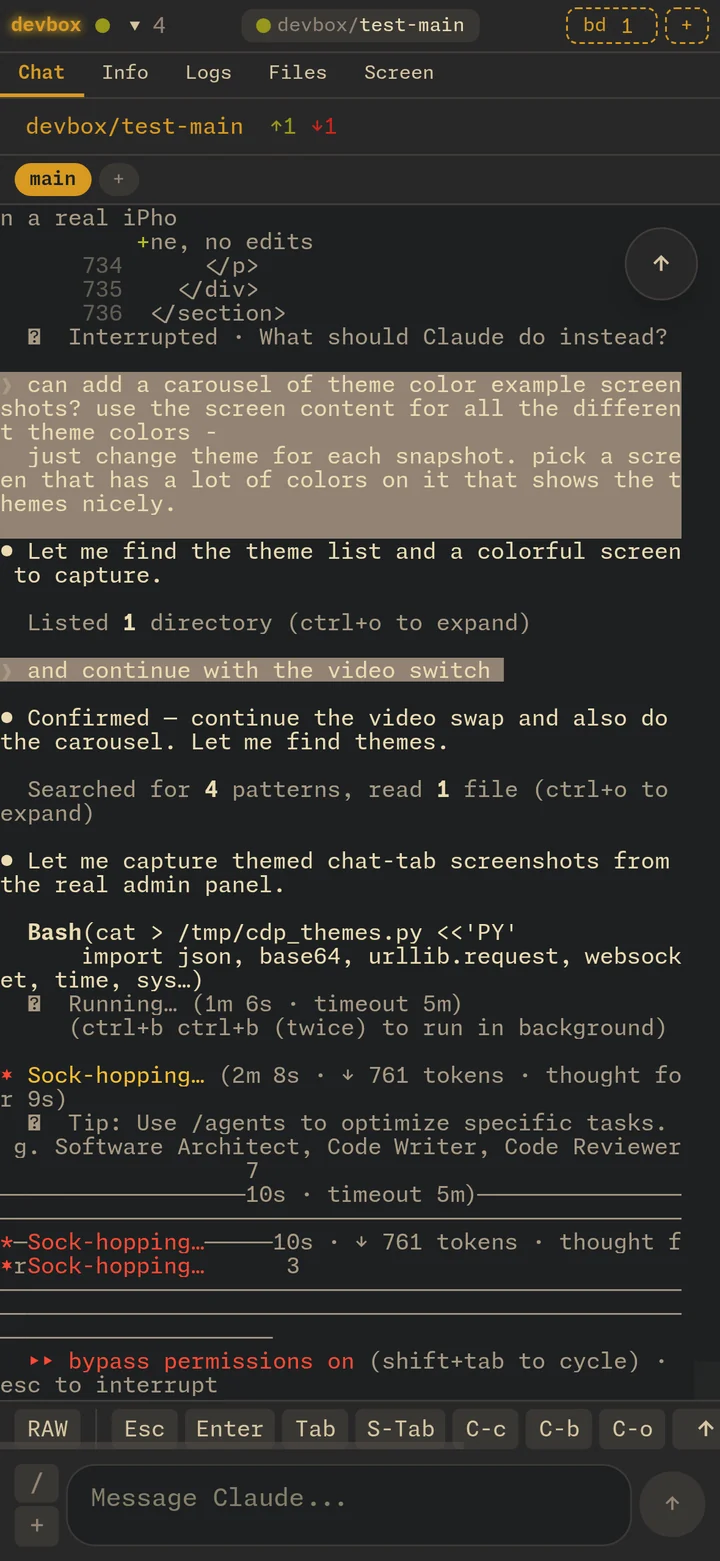
Full xterm.js fidelity in a mobile chat tab. Spinners, ANSI colors, Claude's status bar — all of it, on a screen that fits in your pocket. iOS keyboard quirks handled. Image paste works.
One bare-metal box. N isolated environments. Each gets its own git worktree, devcontainer, Chrome tab, and tmux session. Sub-claudes inside each env share a branch when you need a swarm.
Beads task graph, live git diff, CDP-driven Chrome screencast, reverse-proxied app URLs with HTTPS, PR tracking, deploy hooks. The whole loop from idea → bead → branch → ship.
A real iPhone session: drive Claude through chat, ship a PR, hop into settings, jump to the Screen tab to see the rendered page. The hero up top shows the iOS keyboard side; this clip is the shipping side.
▸ clip at 2× · ▸ recorded on a real iPhone, no edits
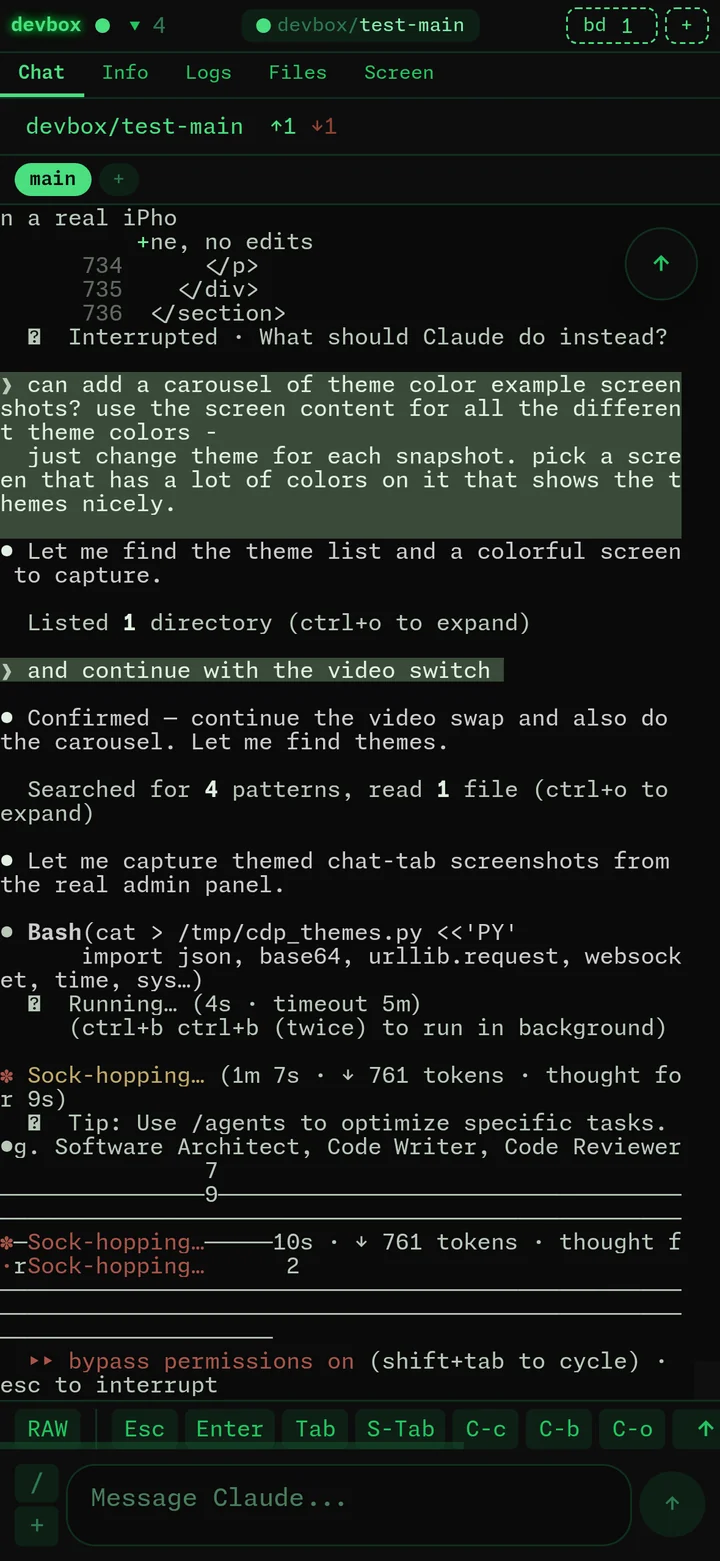
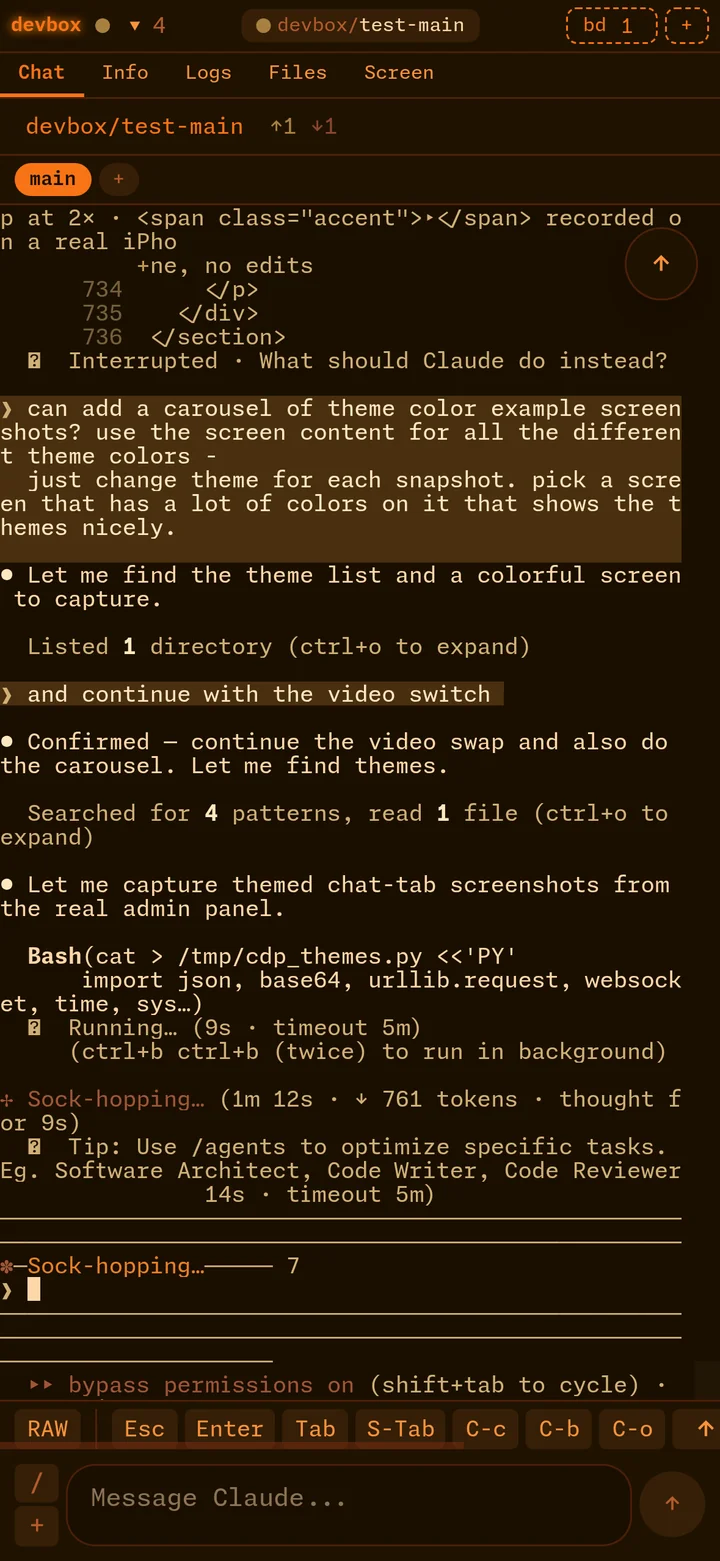
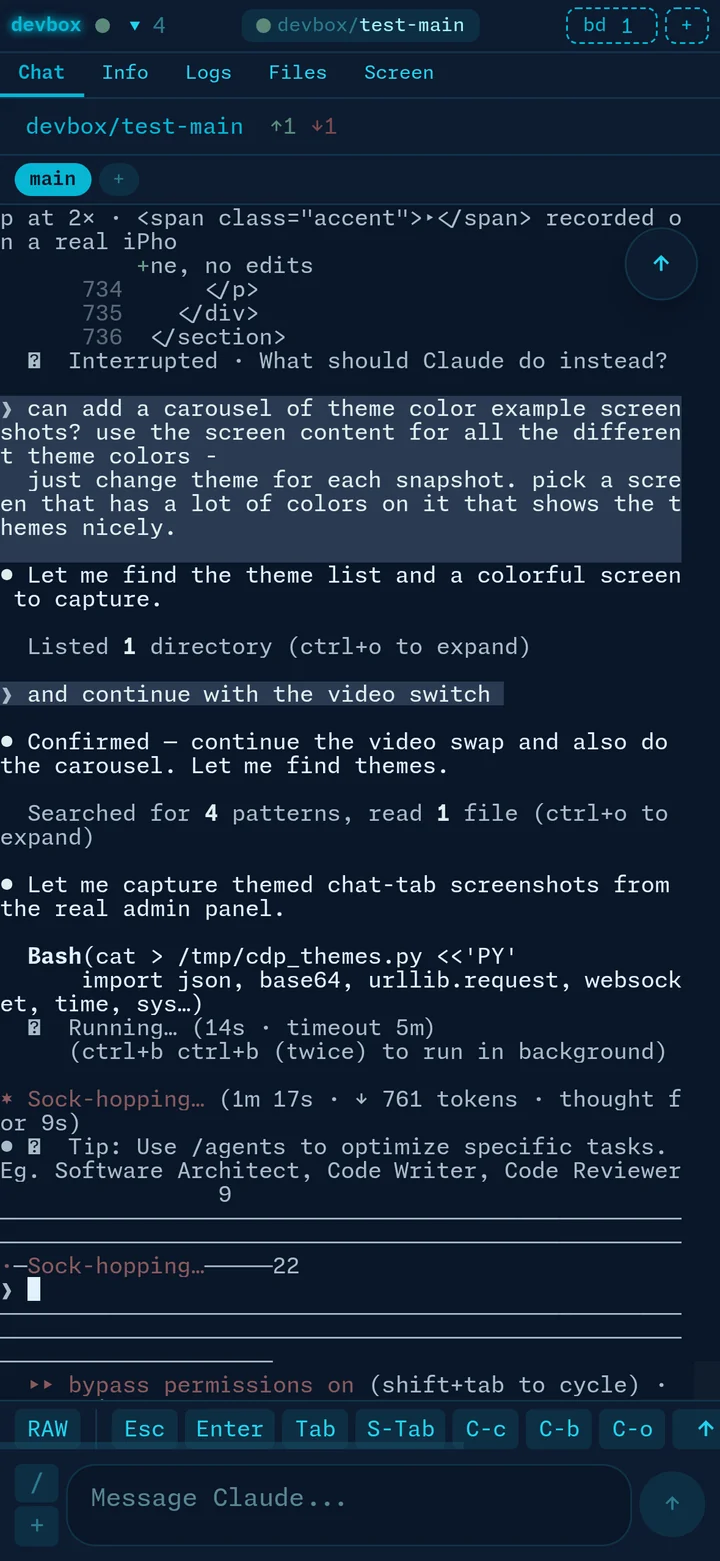
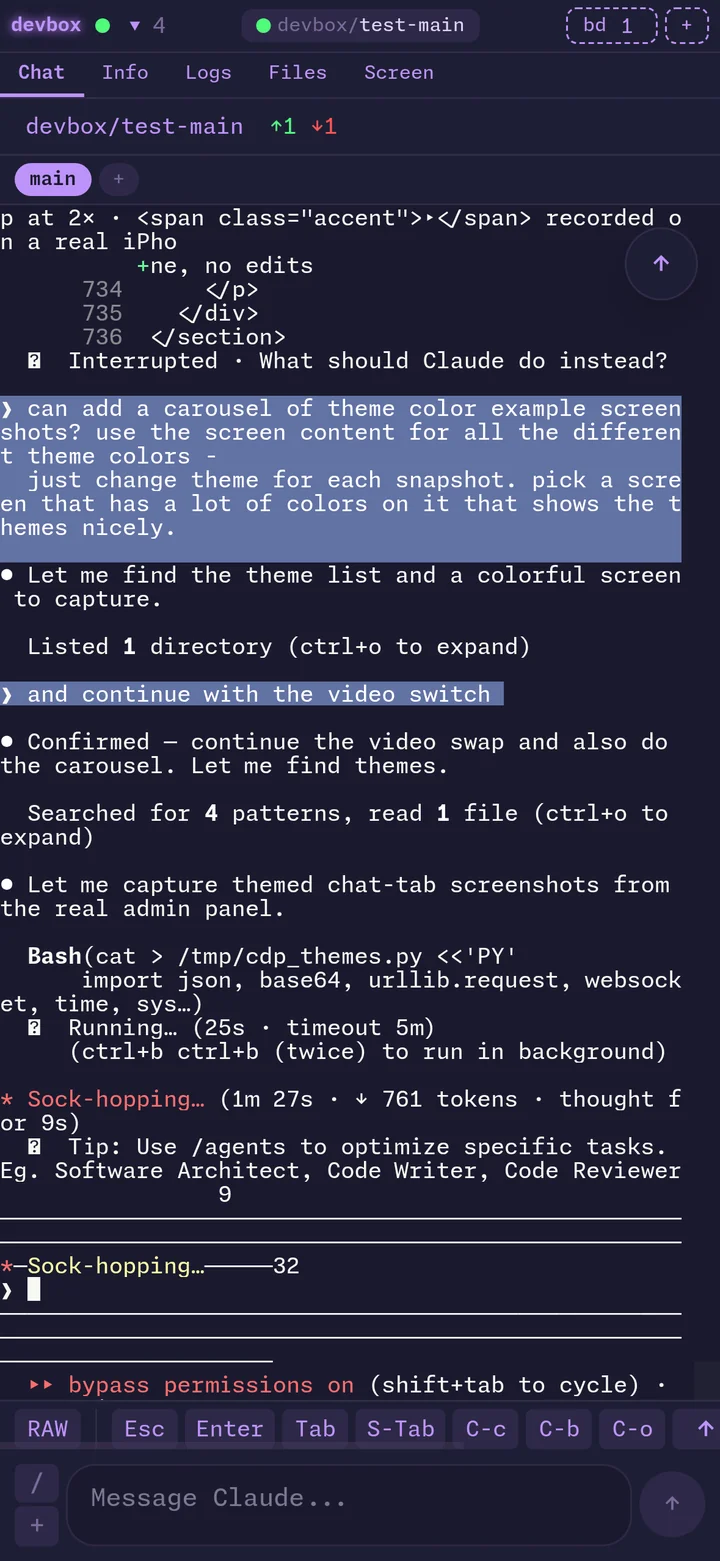
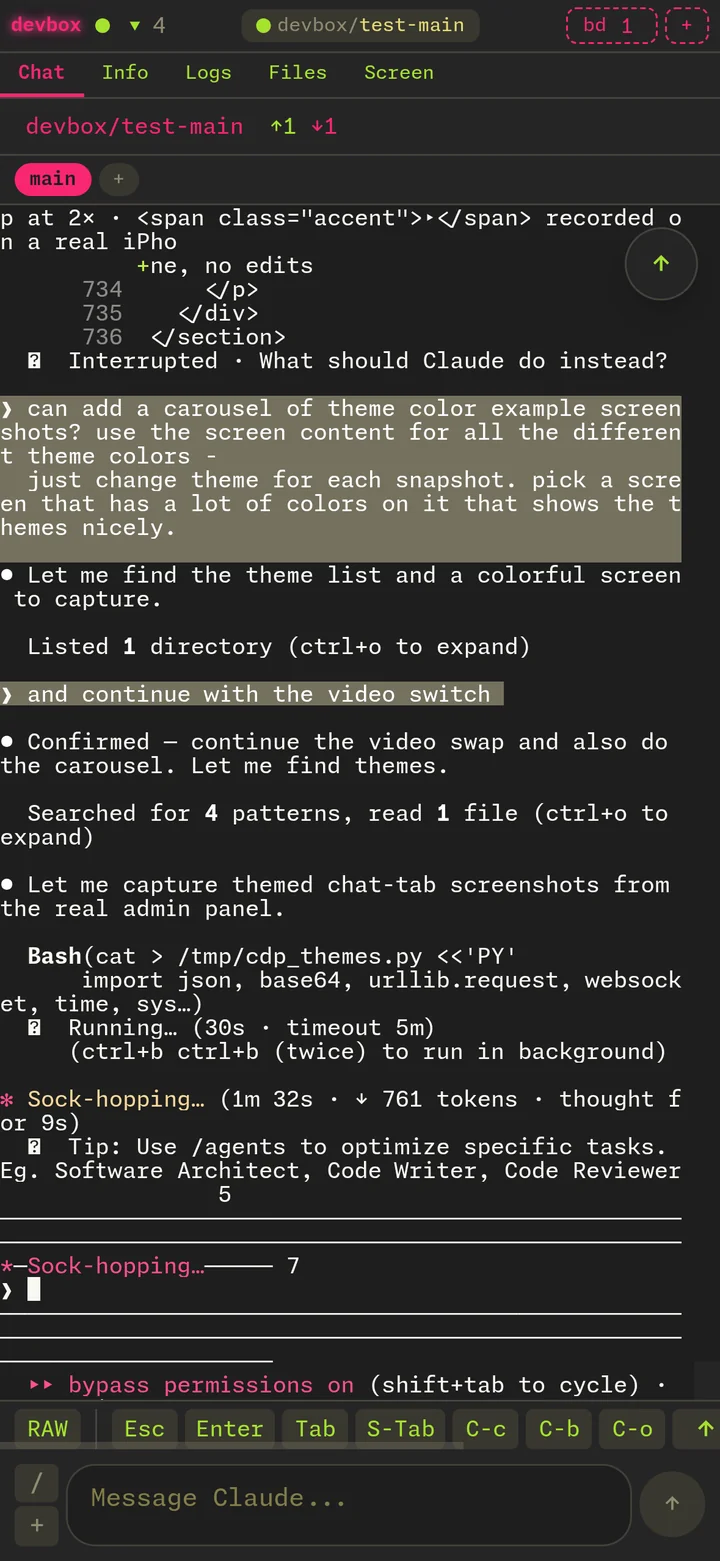
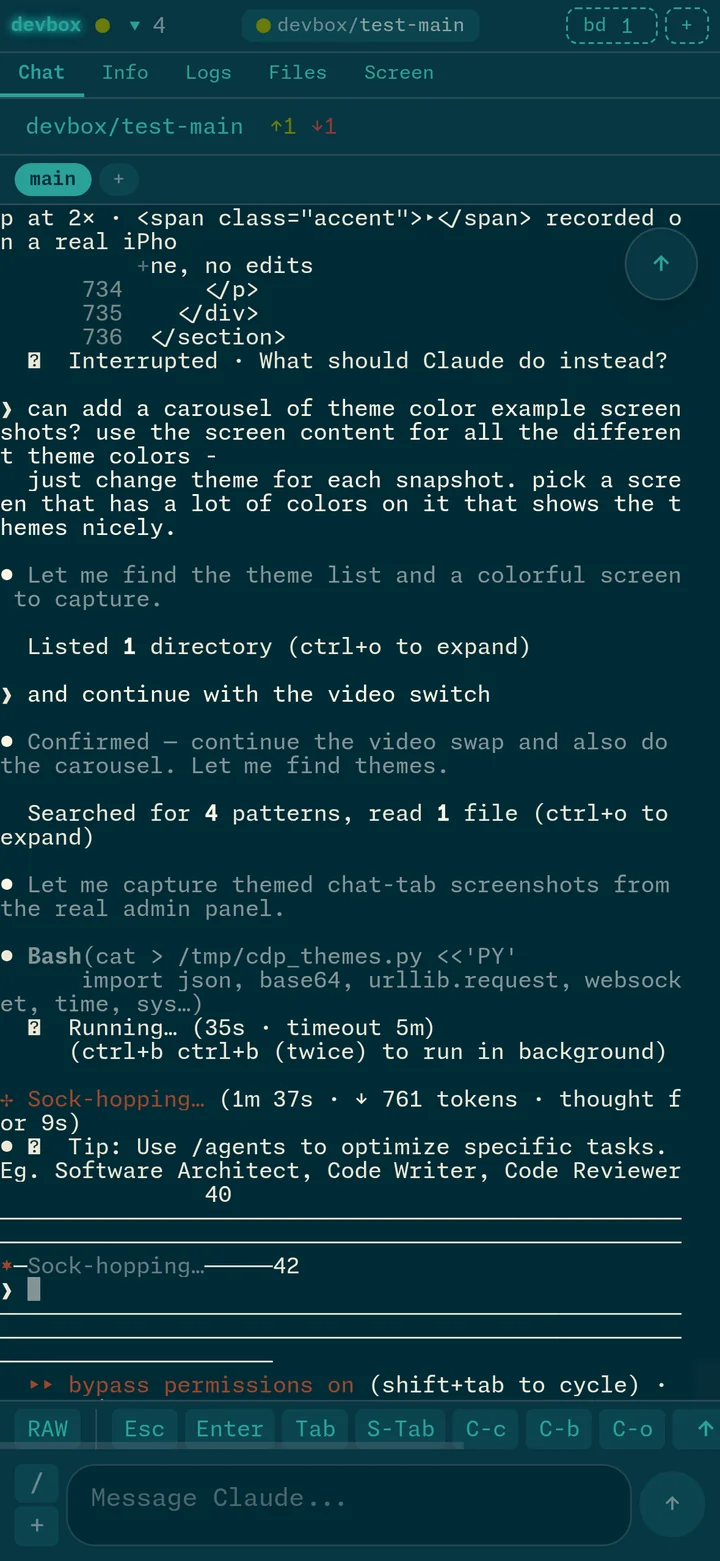
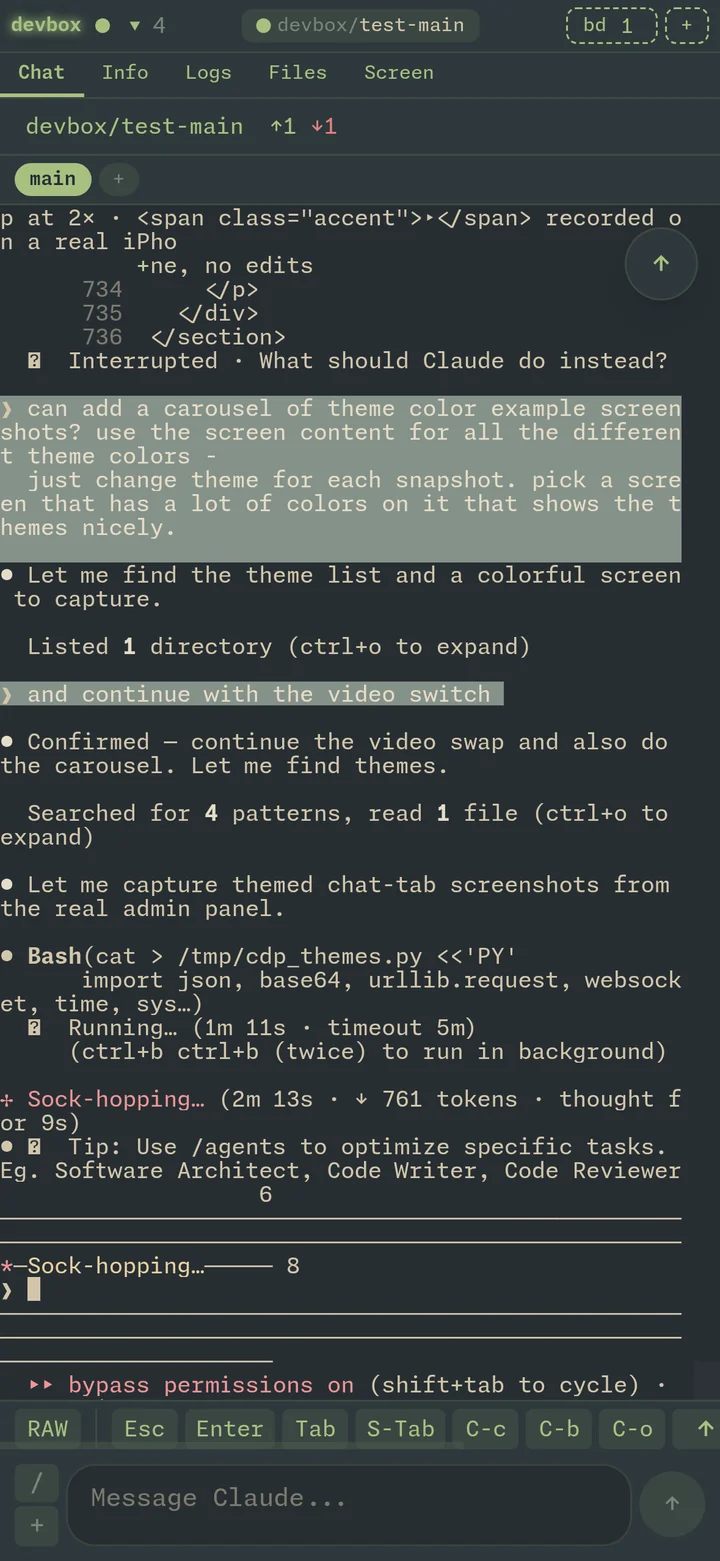
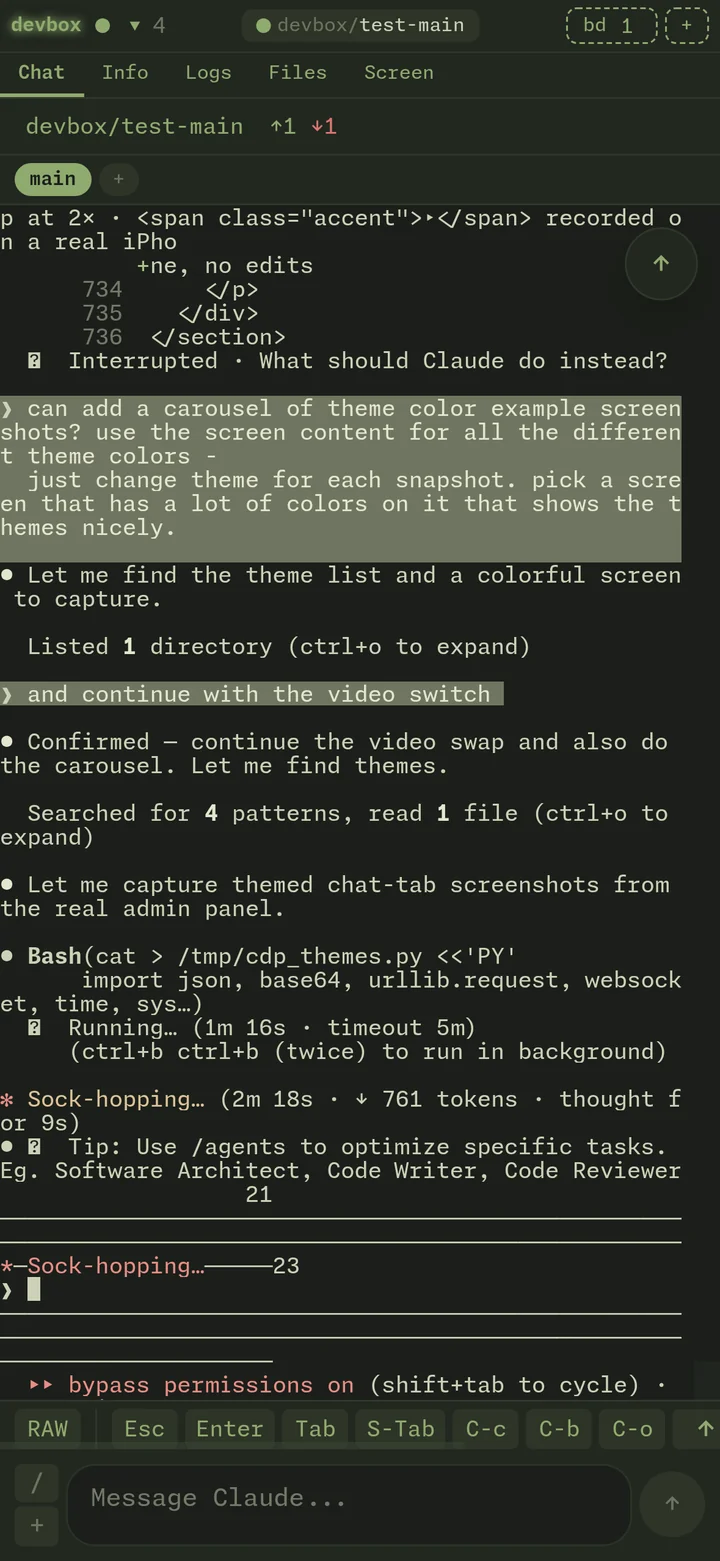
The Chat tab — same Claude session, same ANSI output — under each of the eighteen built-in themes. Swipe through. Pick the one that matches your mood, your wallpaper, or just the lighting in your kitchen.
▸ swipe, tap arrows, or pick a dot · ▸ all 18 ship in the box
The Chat tab is a tmux -C attach-session stream piped through a WebSocket into xterm.js. No screenshots, no polling — every keystroke Claude prints lands in your hand in real time.
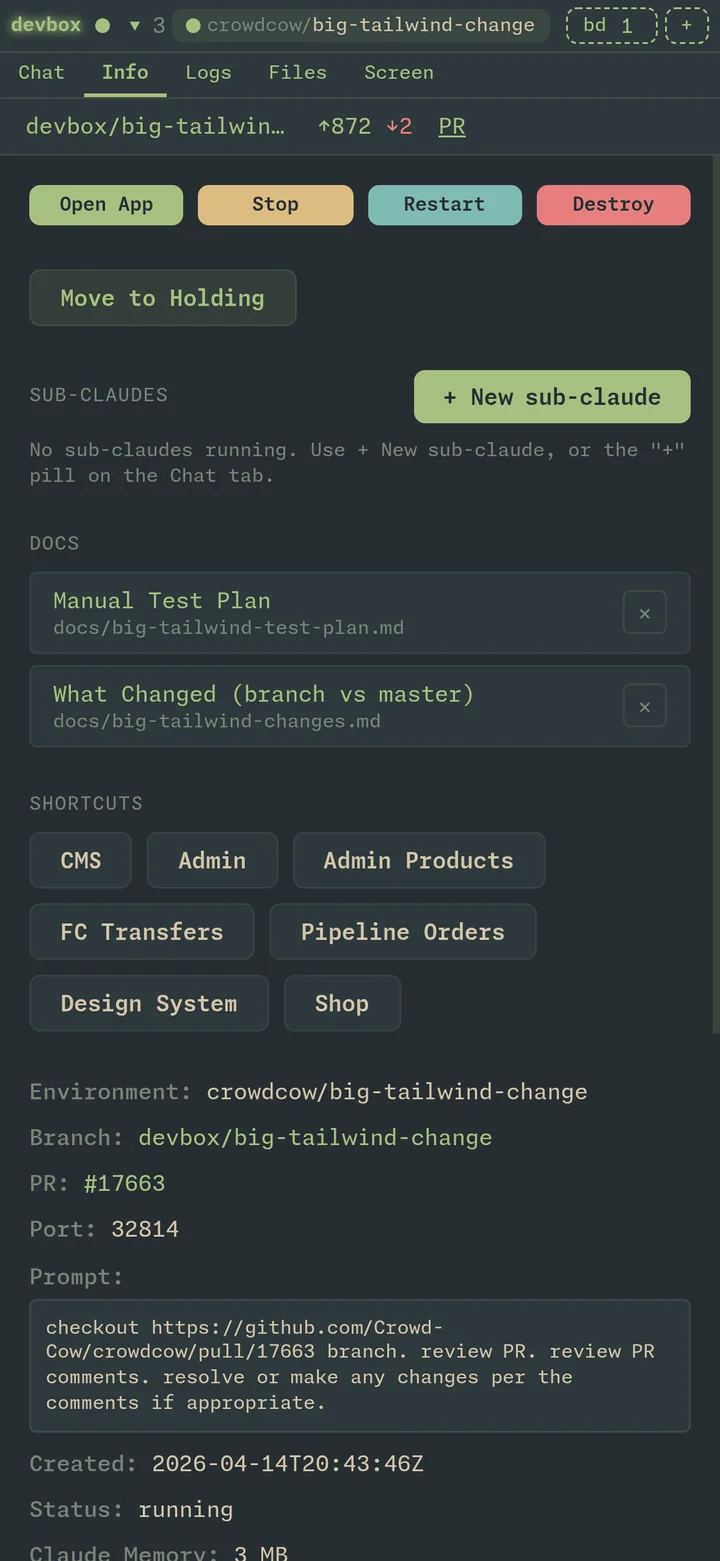
One screen with everything: start/stop/restart, sub-claude roster, project shortcuts, PR link, branch state, the original prompt, container memory, doc attachments. The kind of dashboard you'd build for yourself if you didn't have to ship features for a living.
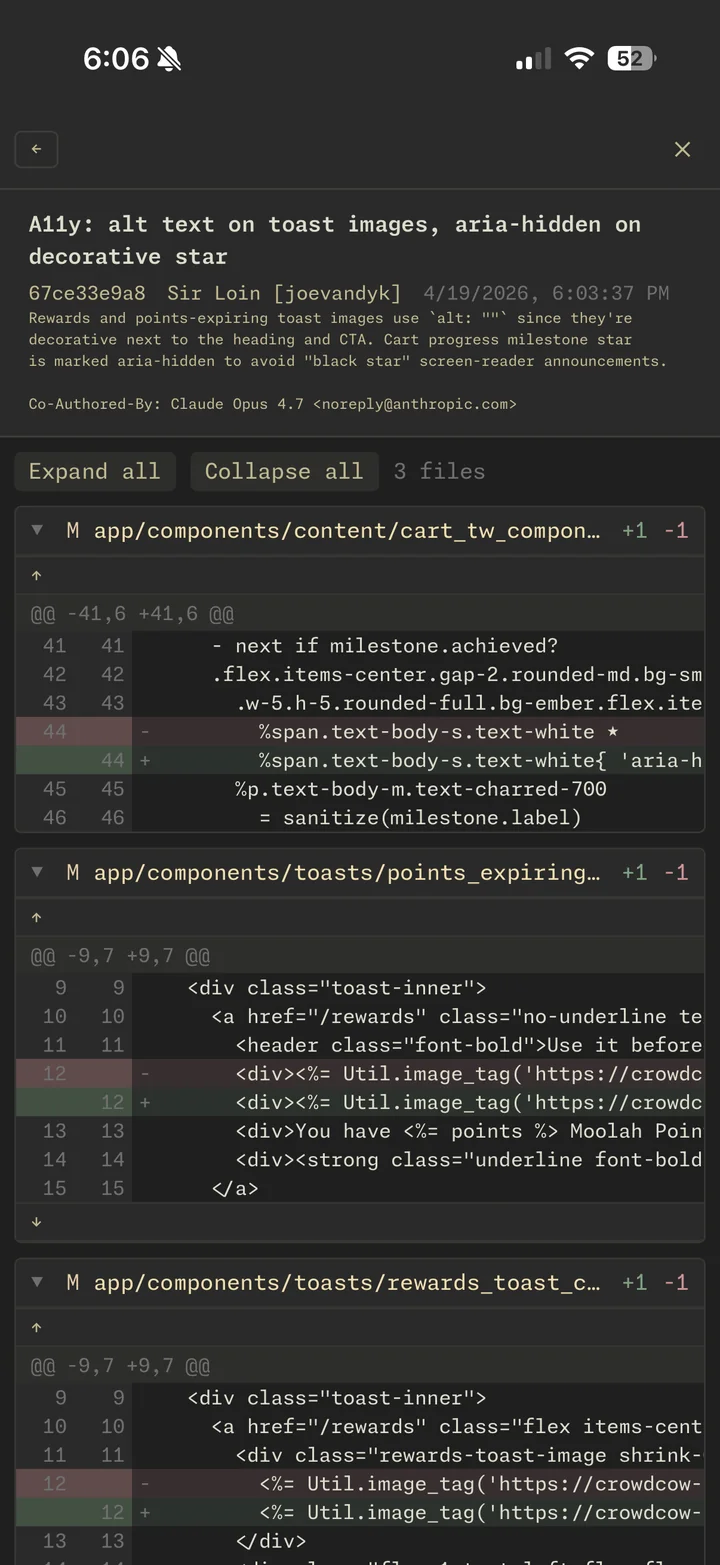
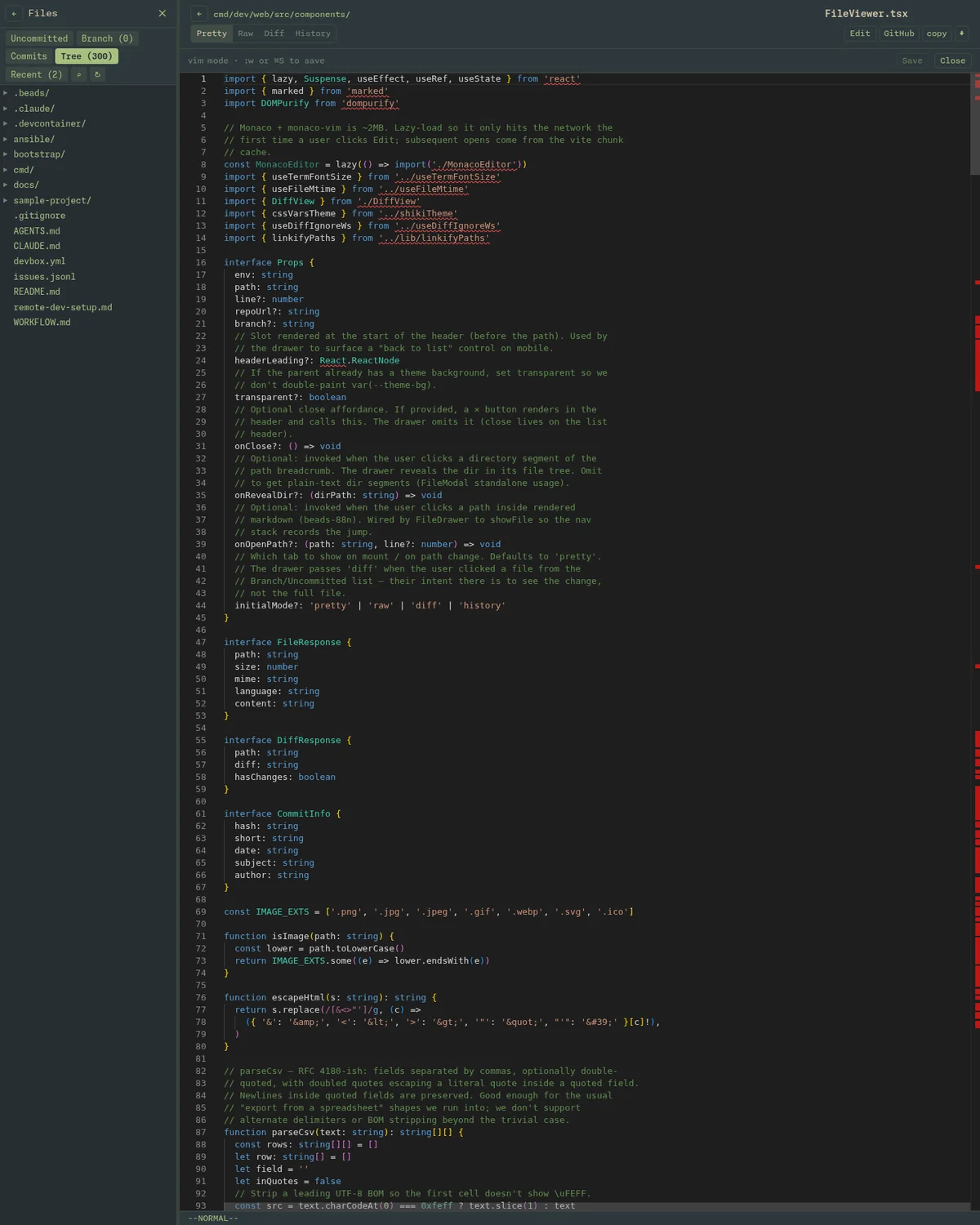
A drawer that overlays any tab: tree view, recent edits, uncommitted changes, branch-vs-master, commit history. Tap a file → syntax-highlighted preview with diff coloring keyed to the active theme. Eighteen themes, all hot-swappable.
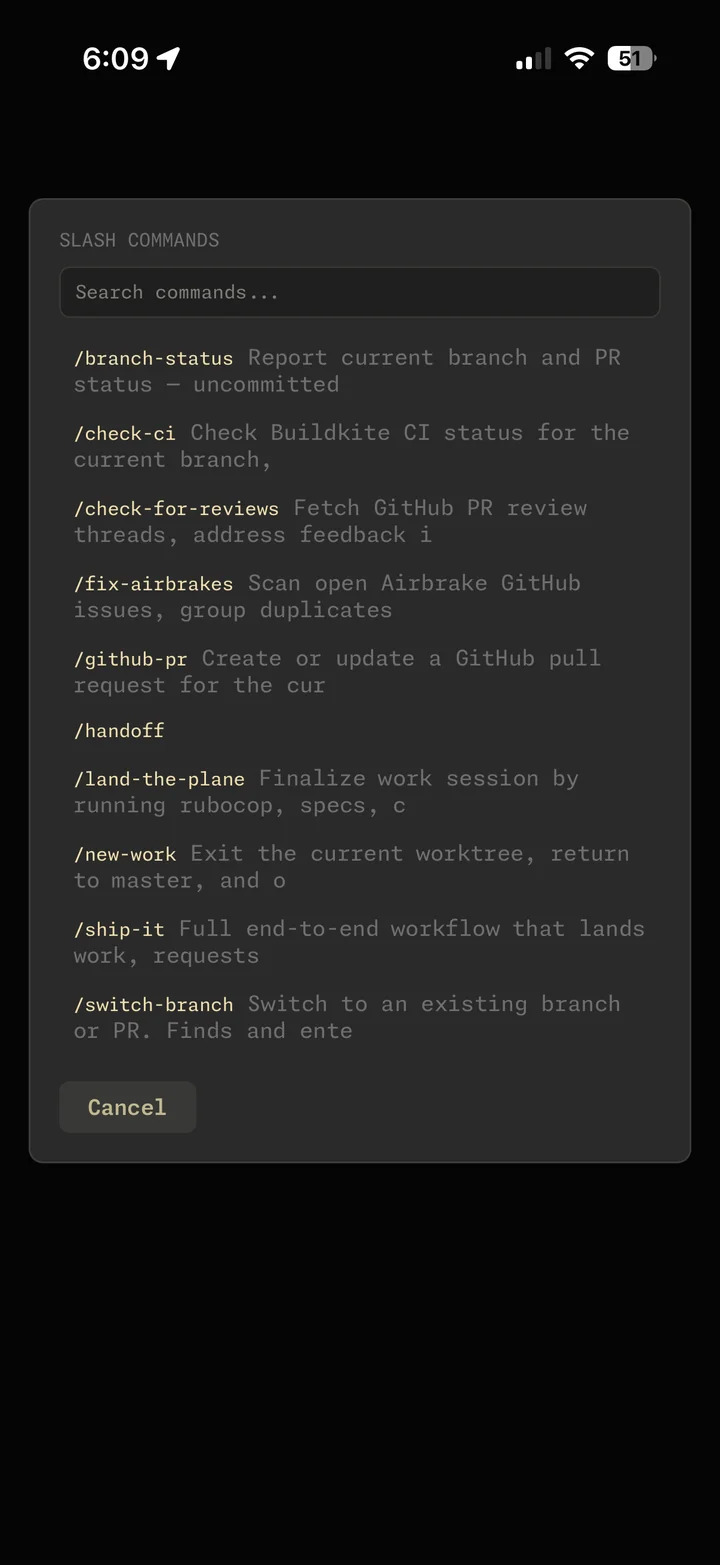
Type / from the chat tab and a palette slides up: every slash command and every superpower skill, fuzzy-matched, built-ins and project-specifics interleaved. Tap one, it lands in the prompt with placeholders for arguments. The same UX you have on desktop, finger-friendly.
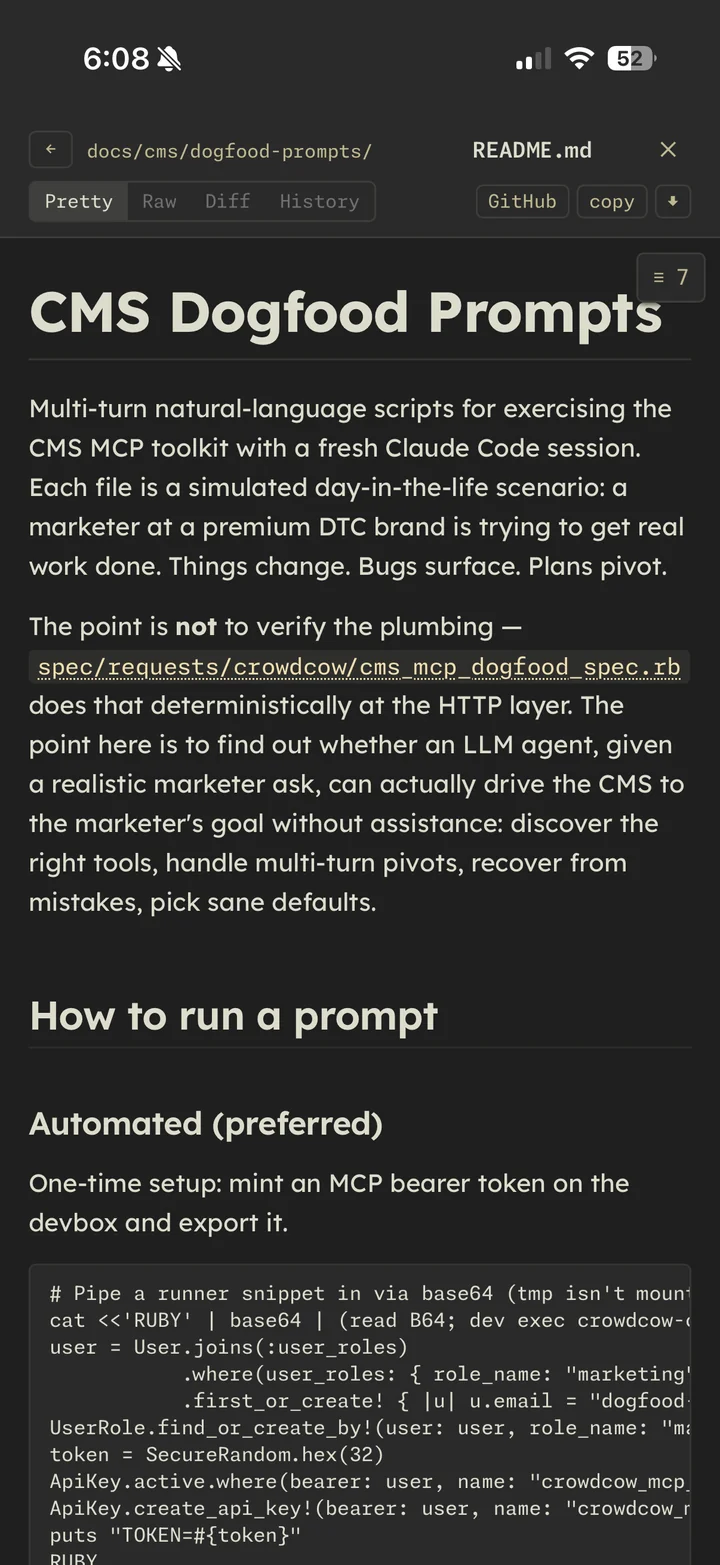
Tap any .md path in Claude's output — handoff notes, plans, specs — and it opens in a styled viewer with the same theme as the rest of the app. Headings, code fences, tables, syntax highlighting. The Info tab can pin a doc so it's one tap away forever.
Beads is the connective tissue: a Dolt-backed task graph where every idea, plan, commit, PR, and env links back to a node. Open an epic — the children show up as a tree, with rolled-up status, stale flags, and the events that touched each one. The drawer spans projects.
The same app fills a 30-inch display at the office: tabbed env switcher, split panes, a beads drawer that spans projects, a screen tab that proxies CDP screencast from each env's headless Chrome — clickable, typeable, no VNC. All my development now happens inside devbox — phone in the morning, big monitor at the desk, same envs, same conversations, same worktrees.
Click Edit on any file and the viewer flips into Monaco — the same editor that ships in VS Code — with vim keybindings on by default. Saves write straight through to the worktree on disk; Claude sees the change on the next read. No git dance, no copy-paste, no "let me jump on my laptop real quick."
Claude Code runs on bare metal, editing files directly. The app it's working on runs in a Docker devcontainer. The worktree is bind-mounted in. Edits land instantly. Containers are disposable. Claude isn't.
dev new crowdcow checkout-redesign // worktree + container + Claude dev sub crowdcow-checkout-redesign tests // spawn a sub-claude on the same branch dev list // every env across every project dev exec <env> bundle exec rspec spec/... // run anything inside the container dev destroy <env> // tear it all down: tmux, chrome, worktree, container
senior engineer · crowd cow · seattle
Joe builds the web app at Crowd Cow — a DTC meat & seafood subscription on Rails 7. He spent a chunk of 2026 figuring out how to make Claude Code work the way he works: from a phone, in parallel, across feature branches, without losing track of anything.
Devbox is the result. It is unapologetically personal. Every decision was driven by a real ticket Joe was trying to ship — terminal fidelity on iOS Safari, sub-claudes that share a worktree, beads as the connective tissue across commits/PRs/envs, a CDP-driven Chrome view because VNC was too blurry on retina displays.
It started as a tmux window over SSH and an idea — "what if I could just talk to Claude from my phone?" Every feature on this page — the file drawer, the screen tab, sub-claudes, the beads graph, the IDE, this very landing page — was built by Claude Code running inside a devbox env, on the devbox repo. The tool ate itself into existence. Every commit is a dogfood receipt.
It runs one developer hard. The point isn't that you should use it. The point is that this is what 2026 dev tooling can look like when one person decides to optimize their own workflow all the way down to the metal.
A real session, sped up 3×: spin up a fresh worktree, hand Claude a one-line prompt ("make the site purple"), and watch it think, plan, and edit. Same admin panel Joe runs from his phone — just bigger.
▸ 2 min · 3× speed · no audio · captured live